
24/7 Mobile Truck Repair
Listed · public sourceDallas–Fort Worth; Houston is named on their service-area list · Mobile24/7 claimed
- Engine
- Transmission
- Tires
- Mobile roadside
- +2
The contact block says “24 Hours a Day / 7 Days a Week
Specialty guide · tires & roadside
Heavy-duty truck tire repair and roadside service in Houston — duals, blowouts, mobile mounting, and which listed shops run 22.5s on the shoulder.
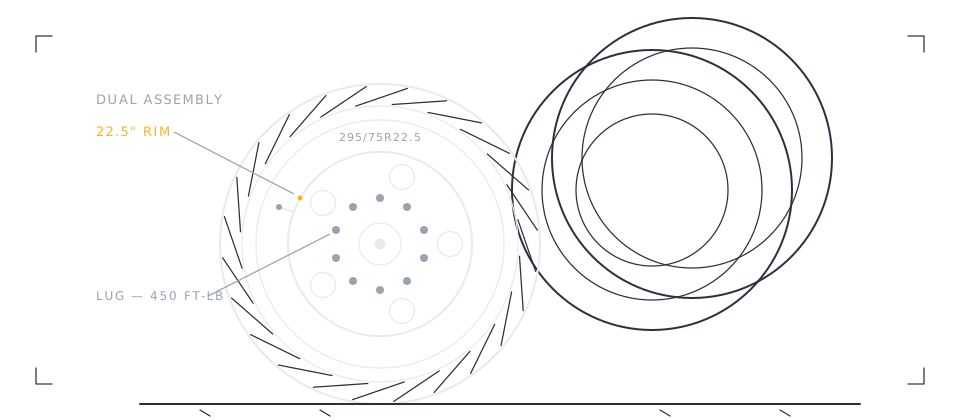
Truck tire work is its own trade, and it is not a car tire shop with a balancer and a waiting room. A class 8 rides on 22.5-inch wheel assemblies; a mounted dual is a couple hundred pounds of rubber, steel, and stubborn; and the shop that does this right has a heavy-duty tire cage, a clip-on inflation chuck with a remote gauge, and a technician who treats every multi-piece wheel like the pressure vessel it is. Split rims and multi-piece assemblies store serious energy at highway pressures, and the cage is the difference between a bad day and a life-changing one — anyone who handheld-inflates a multi-piece wheel in front of you is showing you exactly how the rest of the shop is run. Roadside tire service adds a layer on top of all that: a service truck with a crane, a jack rated for a loaded axle, and the ability to demount, repair or replace, and remount a dual assembly on a shoulder, in a terminal yard, or at a dock in Baytown.
Houston duty cycle is hard on casings. Drayage trucks turning tight laps in the port terminal yards eat curbs and take container-weight turns that scrub shoulders off steer tires; the industrial corridors — I-10 east, I-69, US-90 along the Channel — carry a steady rain of debris, strap hardware, and road scrap that finds tire crowns; and Gulf Freeway summer heat does the rest. Watch steer tires closest of all: they carry the weight, they steer the terminal laps, and they are the first thing a roadside inspection measures — a scrubbed shoulder on a steer is a citation waiting for a scale house on I-10. The classic stranding is the neglected inner dual: hard to reach with a gauge, easy to skip, and the one that runs soft, overheats, and lets go at speed. When a casing goes, it takes the mud flap, the light bracket, and sometimes the air lines with it, and now a tire call has become a tire call plus a mobile mechanical call. The trucks that avoid this are the ones whose drivers or shops check both duals — actually gauge in hand, inner and outer, on a schedule — instead of reading the outer sidewall and calling it done.
Repair or replace is a question with a real answer, and the location of the injury decides it. A puncture in the crown — the belt area of the tread, up to about 3/8 of an inch — is repairable, and the repair that counts is done from the inside: demount the tire, clean and buff the injury, install a patch-plug through it, remount, and air it back up in the cage. A string plug shoved in from the outside on the shoulder of the Gulf Freeway gets you to the yard; it is not a repair, and no DOT inspection treats it as one. Sidewall and shoulder injuries are not repairable at all — those zones flex too much to hold — and a shop willing to patch one is selling you a future blowout at highway speed. The same honesty applies to casing placement: recap casings are legal and sensible on drive and trailer positions, never on steers, and the federal tread minimums for a DOT pass are 4/32 on steers and 2/32 on drives and trailers. The roadside money splits the way the mobile repair page describes: the trip fee is billed before the tire work itself, so get the trip number and the repair-versus-replace call settled on the phone before the truck rolls.
Most of the roadside tire business is preventable with checks that take ten minutes. Gauge both duals, inner included — a boot heel is not a pressure check and never was. Watch for mismatched duals: two tires of different diameters across from each other drag the smaller one and wear it dead, so a replacement dual needs to measure against its partner, not just fit the rim. Keep steer treads ahead of the 4/32 line before an inspection finds them for you, rotate per wear rather than per habit, and pull the nails and staples you find in crowns before they work deeper. And when the blowout does happen — because in this town, eventually, it will — set the triangles before you touch anything, keep your body off the travel lane, and make the call with your location and axle position ready. The heavy roadside units in these listings roll tires and mechanical both. Save a roadside tire number before you need it — before two in the morning finds you on Beltway 8 with a shredded dual.
Listings
9 listed · filtered from 40
Dallas–Fort Worth; Houston is named on their service-area list · Mobile24/7 claimed
The contact block says “24 Hours a Day / 7 Days a Week
Mobile within 100 miles of Houston, their site says · Mobile24/7 claimed
24-hour roadside service advertised
Katy, Cypress, and Fulshear · Shop and mobile24/7 claimed
Shop: Mon–Fri 8:00am–5:00pm; Sat 9:00am–1:00pm
Conroe area — three locations (North Conroe, South Conroe, New Waverly) · Shop and mobile24/7 claimed
North Conroe: Mon–Thu 8:00am–6:00pm, Fri 8:00am–5:30pm (their site)
Houston shop on Langley Rd + statewide Texas mobile · Shop and mobile24/7 claimed
24 hours, 7 days a week advertised
East Houston (Oates Rd / 610 East) · Shop and mobile24/7 claimed
24/7 emergency service advertised; shop hours not posted
Tomball / NW Houston, mobile · Mobile24/7 claimed
24/7 mobile service advertised
Conroe HQ; regional service across Texas, Oklahoma, and Louisiana · Shop and mobile24/7 claimed
24/7 breakdown line; shop service during the day (their site)
West Houston (Bellaire Blvd / Alief) · Shop
Hours not confirmed